Hannah had always imagined her wedding day as something warm, emotional, and shared equally between the people she loved most.
For months, she had planned every detail with Luke—choosing flowers, tasting cakes, arranging seating, and coordinating music. Luke had been involved, but when it came to one particular element, he had been unusually secretive.
“There’s a family tradition,” he had told her one evening while they were reviewing plans. “It’s something I want to surprise you with on the day. It’s meaningful to my family. You’ll understand when it happens.”
Hannah had hesitated.
She wasn’t against traditions, but she believed weddings should be built on transparency. Still, Luke seemed certain it would be special, and she trusted him. In the end, she agreed not to press for details.
“It’s going to be romantic,” he promised with a smile. “You’ll see.”
So she let it go.
But a small discomfort remained, the kind that doesn’t disappear completely even when you try to ignore it.
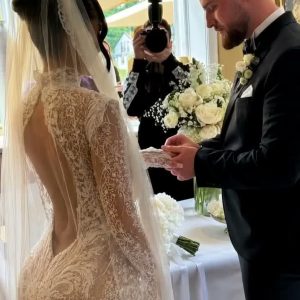
On the morning of the wedding, Hannah woke with a mixture of excitement and nervous anticipation. The church had been decorated beautifully. White flowers lined the aisle, sunlight streamed through stained glass windows, and everything looked exactly as she had envisioned in her planning notes.
As she prepared in a nearby room with her mother and sister, laughter filled the space. Friends came in and out, helping with her dress, adjusting her veil, offering encouragement. It felt normal. Joyful. Right.
Until it was time to walk into the church.
The moment Hannah stepped forward, something felt off.
The church doors opened.
Music played.
She took her first steps inside expecting to see a full room of family and friends waiting to witness one of the most important moments of her life.
Instead, she stopped.
Confusion replaced excitement almost instantly.
Every single person seated inside was a man.
Her father stood near the front, looking proud. Her uncles were seated beside him. Male cousins filled the rows. Luke’s male relatives were present as well, dressed formally, watching her with polite smiles.
But there was no sign of her mother.
No sister.
No female friends.
No aunts.
No women at all.
Hannah froze in place, her bouquet suddenly feeling heavier in her hands.
For a moment, she wondered if she had entered the wrong room. If this was some staged rehearsal or pre-ceremony gathering she hadn’t been informed about.
But then she saw Luke standing at the altar.
Smiling.
Waiting.
As if everything was exactly as planned.
Her heartbeat quickened.
She took another step forward, confusion turning into alarm.
“Where is everyone?” she whispered.
Luke began to respond, but before he could, his father stepped forward slightly and spoke instead.
“It’s our family tradition,” he said calmly, as if explaining something simple and well-known. “The wedding ceremony is attended only by the men. The women are gathered separately to celebrate in another location.”
Hannah blinked.
Once.
Twice.
She looked around the room again, as if searching for confirmation that this was a joke.
It wasn’t.
“This was never discussed with me,” she said, her voice tightening.
Luke finally spoke.
“It’s just how things are done in my family,” he said quickly. “We didn’t think it would be a big deal. It’s temporary. Everyone is still celebrating.”
But Hannah was no longer listening to explanations.
Something inside her had already shifted.
Because it wasn’t just about who was physically present.
It was about choice.
About exclusion.
About being told something significant about her own wedding only after it had already been decided without her input.
She turned slightly and stepped back toward the entrance.
“I need to call my mother,” she said.
Outside the church doors, her hands trembled as she dialed.
Her mother answered immediately.
“Hannah? Are you okay? We’re at the hall—they told us to come here.”
“The hall?” Hannah repeated.
“Yes,” her mother replied. “A bus picked us up after we arrived. They said it was part of the wedding schedule. No one explained anything. We’re all here, but we don’t understand why we weren’t allowed at the ceremony.”
Hannah closed her eyes.
So it wasn’t just her being excluded from information.
It was an entire group of women being separated without explanation.
Directed.
Managed.
Moved like part of an arrangement rather than participants in a shared event.
When she opened her eyes again, she looked back at the church entrance.
Luke was still inside.
Waiting.
Trusting that she would return and continue as planned.
But Hannah felt something settle in her chest.
Clarity.
Not confusion anymore.
Clarity.
Because this wasn’t a misunderstanding.
It was a decision made without her.
And if it could happen now, on their wedding day, then it could happen again in other forms later.
Smaller.
Quieter.
More familiar.
She walked back inside.
All eyes turned toward her.
Luke smiled, expecting her return.
But Hannah did not move toward the aisle.
Instead, she looked at him directly.
“This wasn’t a tradition I agreed to,” she said.
“It’s not about agreement,” Luke replied softly. “It’s about family history. It’s symbolic.”
“To who?” she asked.
The question hung in the air longer than anything else said that day.
Luke didn’t answer immediately.
And in that silence, Hannah understood more than any explanation could have provided.
She slowly turned around.
Not in anger.
Not in panic.
But in certainty.
She walked out of the church.
The doors closed behind her with a quiet sound that felt louder than music had been.
Outside, the sunlight felt different. Sharper. More real.
She stood there for a moment, still in her wedding dress, bouquet in hand, breathing slowly as she processed what she had just done.
Then she got into a car and asked to be driven to the hall where the women were gathered.
When she arrived, the atmosphere inside was confused but warm. People were talking quietly, trying to understand what was happening, when suddenly the doors opened and Hannah stepped in wearing her wedding gown.
The room fell silent.
Every woman turned toward her.
Her mother stood up immediately, concern on her face.
“Hannah?”
Hannah took a breath.
Then she lifted her glass, still holding her bouquet in one hand.
And she spoke.
“To love that includes, not excludes.”
For a moment, no one moved.
Then someone began clapping.
Then another.
And another.
Soon the entire room joined in—not out of celebration for a wedding, but in recognition of something deeper.
Courage.
Choice.
Self-respect.
Hannah sat down with her family afterward. There were tears, but also laughter. Confusion slowly gave way to understanding. Her mother held her hand for a long time without speaking. Her sister leaned against her shoulder. Friends asked questions she didn’t yet have full answers for.
But she didn’t feel alone.
Later that evening, news of what had happened began to spread through conversations, messages, and eventually social media. People reacted strongly—some in support, some in disbelief—but the phrase Hannah wrote in a short post captured attention everywhere:
“I didn’t get married yesterday—I found my voice instead.”
For Hannah, the meaning of that day became clearer with time.
It wasn’t just about a wedding that didn’t happen.
It was about a decision made in real time when something fundamental about respect and inclusion was revealed too late to ignore.
She realized that love is not measured by promises or plans, but by whether both people are truly seen in the decisions that shape their shared life.
And sometimes, the most important step in a relationship is not walking toward an altar.
It is walking away from anything that asks you to disappear in order to belong.