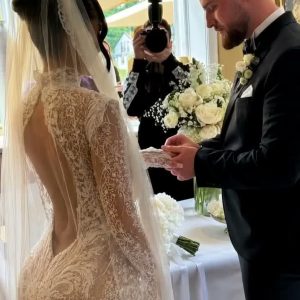
Shelby attended her stepsister Victoria’s wedding hoping for one simple outcome: to stay unnoticed.
Not celebrated. Not acknowledged. Just invisible enough to avoid conflict.
That had become her usual role in the family—present, but never truly seen.
From the moment she arrived at the elegant venue, she could feel the familiar pattern settling into place. Guests greeted Victoria with admiration, compliments flowing effortlessly around her designer dress, her carefully curated smile, and the storybook wedding she had spent months showcasing to everyone who would listen.
And then there was Shelby.
Standing slightly apart. Dressed modestly. A guest who seemed to exist more out of obligation than belonging.
Even the seating chart reflected it.
Her name was misspelled.
Not dramatically, not insultingly obvious—just carelessly wrong, like she hadn’t mattered enough for someone to double-check.
She corrected it quietly with a finger hovering near the card, then let it be. It didn’t feel worth correcting in a place where she had already been mentally categorized long before she arrived.
Victoria, meanwhile, moved through the crowd like a spotlight had been built into her presence. She introduced Shelby early in the evening, tapping her glass lightly to draw attention.
The room quieted.
“Everyone,” Victoria announced brightly, “this is my stepsister Shelby.”
Shelby offered a small, polite smile, the kind she had learned to use in situations where she knew better than to expect warmth.
Victoria continued before Shelby could even settle into the introduction.
“She’s just a nurse,” she added, with a laugh that was meant to sound casual but carried just enough edge to reshape how people looked at her.
A ripple went through the crowd.
Not everyone laughed, but enough did.
A few polite chuckles.
A few surprised glances.
And worst of all—her father, seated near the front, laughing a little too easily, as if the joke didn’t include her.
Shelby felt the words land, not like a sudden blow, but like something familiar pressing down on a bruise that had never fully healed.
Just a nurse.
As if the word “just” made the rest of her life smaller.
As if the emergency room, the long shifts, the moments where seconds decided whether someone lived or died, were somehow less than what others did at office jobs or corporate dinners.
She kept her expression steady.
That was something she had learned early—not to give anyone the satisfaction of seeing the hurt land.
Instead, she quietly adjusted the pearl earrings she wore.
They were her mother’s.
The only meaningful thing she had kept after her passing. Small, elegant, slightly worn at the edges from years of careful preservation. They were not valuable in a financial sense, but they were irreplaceable.
And tonight, they grounded her.
As the reception continued, Shelby moved through the evening like a shadow at the edge of celebration. She helped when needed, smiled when spoken to, and stepped back when ignored. It wasn’t unfamiliar. It was almost routine.
What she didn’t notice at first was the man watching her.
Richard Harrington, the groom’s father, had been observing her quietly for much of the evening. Unlike others, his gaze wasn’t dismissive. It was thoughtful, unsettled in a way that suggested recognition he couldn’t yet place.
Eventually, he excused himself from a conversation and walked over to her table.
“May I sit?” he asked.
Shelby hesitated, then nodded politely.
He lowered himself into the chair beside her, careful and unhurried, as if the moment required respect rather than intrusion.
For a moment, neither of them spoke.
Then Richard exhaled slowly.
“I hope this doesn’t sound strange,” he began, “but I think I know you.”
Shelby looked at him more closely. There was something familiar in his voice—not his face, but the cadence of it. Like a memory she couldn’t quite retrieve.
“I’m sorry,” she said gently. “I don’t think we’ve met.”
“I don’t think we’ve met formally,” he corrected. “But you helped me once.”
That made her pause.
Richard’s gaze shifted slightly, as though he was looking somewhere far beyond the wedding hall.
“Three years ago,” he continued, “I was in a terrible car accident. My vehicle flipped off the highway during a rainstorm. I was trapped inside for nearly an hour before emergency services could extract me.”
Shelby listened quietly, her expression steady but attentive.
“I thought I was going to die in that car,” he said. “I remember the panic most. The sound of the rain, the broken glass, and the feeling that no one was coming fast enough.”
His voice lowered slightly.
“But someone was already there before the paramedics arrived.”
Shelby’s fingers moved instinctively toward her earrings again, though she wasn’t aware of it yet.
Richard continued.
“There was a nurse. Off-duty. She stopped at the scene before emergency responders fully arrived. She stayed with me the entire time. She talked to me, kept me conscious, kept me calm.”
He paused.
“And she told me about her mother’s pearl earrings,” he said quietly. “I remember that clearly. She said she wore them to remind herself why she chose her profession.”
Shelby’s breath caught slightly, though she didn’t move.
Her hand was now resting lightly against the pearls in her ears.
Richard noticed the gesture.
His expression shifted.
Slowly, carefully, as if the realization didn’t want to arrive too suddenly.
“You…” he said.
Shelby looked at him, unsure.
Richard leaned forward slightly.
“You’re her,” he said.
The words weren’t loud.
But they changed the entire shape of the moment.
Shelby didn’t respond immediately. Not because she didn’t understand, but because she rarely connected that version of herself—the one from emergencies, chaos, and urgent care—with the person sitting at a wedding table being dismissed as “just a nurse.”
“I… I don’t remember every patient,” she said honestly.
“That makes sense,” Richard replied quickly. “There were many. But I remember you.”
He shook his head slightly, as if still trying to process the coincidence.
“You kept talking to me,” he said. “You didn’t let me panic. You stayed until I was out. I never forgot that.”
Shelby finally lowered her hand from her earrings.
The noise of the reception seemed distant now, as if the world had quietly shifted its focus to their table.
“I’m glad you’re okay,” she said softly.
Richard studied her for a moment longer.
Then his expression hardened—not with anger, but with clarity.
“I don’t think everyone here understands who you are,” he said.
Shelby gave a faint, almost resigned smile. “They don’t need to.”
But Richard didn’t seem satisfied with that answer.
The evening continued, but something had changed for him. He didn’t leave her side completely. He returned once or twice, asking small questions—about her work, about her shifts, about how long she had been a nurse. Shelby answered briefly, not drawing attention to herself, not inviting it either.
Eventually, dinner transitioned into speeches.
Victoria stood again, glowing with pride as guests applauded her marriage, her family, her carefully constructed image of success.
And once more, Shelby was reduced in passing remarks—mentioned lightly, framed again as “just a nurse,” as if that definition contained her entire identity.
This time, however, Richard did not laugh.
He watched quietly.
Then he stood.
The room shifted slightly as he approached the microphone.
At first, people assumed it would be a short toast. A polite acknowledgment from the groom’s father.
But Richard did not raise a glass.
Instead, he looked across the room until his gaze landed on Shelby.
“I’d like to share something,” he said.
The room quieted.
Not fully, but enough.
Three years ago,” he began, “I was in a car accident that nearly took my life.”
He described it plainly. No embellishment. No dramatization. Just truth.
Then he continued.
“I survived because a nurse stopped to help me before anyone else could reach me.”
A pause.
“And I didn’t know her name then,” he said, “but I know it now.”
His gaze moved again to Shelby.
“That nurse is here tonight.”
The room shifted.
Confusion. Curiosity. Uneasy recognition.
Richard continued.
“The woman my family was told is ‘just a nurse’ is the same person who stayed with me in one of the worst moments of my life. She kept me alive long enough to make it out of that car.”
A murmur spread through the guests.
Victoria’s expression stiffened slightly for the first time all evening.
Richard’s voice remained steady.
“And because of her compassion, her training, and her courage, I established a foundation dedicated to emergency care support.”
He paused.
“And tonight,” he said, “I’m announcing the first recipient of our nursing scholarship.”
The silence became absolute.
He nodded toward Shelby.
“It is her.”
For a moment, no one moved.
Then applause began.
Not hesitant this time.
Sincere.
Sustained.
Shelby remained seated, overwhelmed but not dramatic in her reaction. She didn’t look at Victoria. She didn’t need to.
The truth had already spoken louder than any introduction.
Later, as the reception continued in a changed tone—less performative, more uncertain—Victoria’s earlier words lingered in the air like something brittle finally breaking.
But Shelby did not engage in confrontation.
She did not argue.
She did not seek revenge.
She simply remained herself.
A nurse.
The same one who had been dismissed earlier.
The same one who had once been reduced to a joke.
And the same one who had, without recognition or applause, saved a man’s life and been remembered for it when it mattered most.
Weeks later, Richard and his wife invited her to dinner—not as an obligation, but as respect made visible.
And for the first time, Shelby understood something she had always known but rarely seen reflected back at her:
Being “just a nurse” had never been small.
It had meant standing in the moments where life was fragile, and choosing to stay anyway.