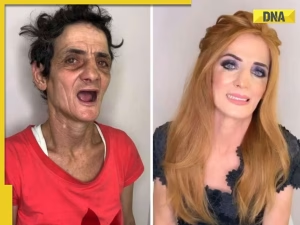
Rita lived a life most people passed without noticing. She moved through the edges of the city like a quiet shadow—present, but rarely acknowledged. People walked past her on sidewalks without eye contact, adjusted their paths slightly in doorways, or focused intently on their phones as if the world around them had narrowed to something safer and more familiar. To most, she was just another person collecting bottles, searching through bins, or sitting quietly with a paper cup placed carefully beside her.
But Rita had not always been invisible.
There had been a time when she woke up in a small, warm apartment with sunlight spilling through clean curtains. A time when she made breakfast for two, packed lunches, and listened to the sound of her son’s voice filling the rooms of her home. Her life had once been structured around routines that felt ordinary then, but precious now in memory—school drop-offs, grocery lists, shared dinners, and conversations about the future that always seemed to stretch far ahead.
Everything changed the day her son died.
It was sudden, the kind of loss that doesn’t allow preparation or gradual acceptance. One moment, she was living a life defined by care and responsibility. The next, she was standing in a world that felt unfamiliar, as if the ground beneath her had shifted and nothing stable remained. Grief didn’t arrive gently. It came in waves that took her breath away, that made mornings feel impossible and nights feel endless.
At first, she tried to hold on to structure. She still got up. She still attempted to manage daily tasks. But grief has a way of slowly eroding even the most familiar foundations. Concentration became difficult. Sleep became irregular. Conversations became exhausting. Friends reached out at first, unsure of how to help, but over time, those interactions faded into silence—not out of cruelty, but because people often don’t know how to stay close to someone whose pain they cannot fix.
Rita began withdrawing without fully realizing it. A missed appointment here. A delayed bill there. A day spent in bed that turned into two, then three. Responsibilities accumulated, but her ability to face them diminished. Eventually, stability collapsed under its own weight.
Losing her home was not a single moment, but a slow unraveling. Once she left, she believed it would be temporary. Just until she could regain control. Just until she could think clearly again. But temporary situations have a way of stretching into permanence when no intervention interrupts them.
Without a fixed address, everything became harder. Access to services. Communication. Employment opportunities. Even basic routines that most people take for granted. The city became both shelter and obstacle—full of people, yet isolating in its indifference.
At first, Rita resisted the identity others began to assign her. She still thought of herself as someone who was simply “between situations,” someone who would eventually recover. But over time, repeated rejection and constant struggle began to reshape how she saw herself. When doors close enough times, you begin to hesitate before knocking.
Hope didn’t disappear all at once. It faded slowly, like light dimming at the end of the day. Not gone completely, but harder to trust.
Years passed in this way.
Rita learned the rhythm of survival. Where to find safe places to rest. Which areas of the city were more forgiving. When to avoid crowds. How to stretch a small amount of money across multiple days. She became skilled in ways most people never need to consider. But none of these skills replaced what she had lost most deeply: the sense of being seen.
To most passersby, she was part of the background. A figure that belonged to the edges of attention rather than its center.
Until one day, someone stopped.
It was an ordinary afternoon. The kind of day where nothing suggests change is coming. Rita was sitting quietly near a building entrance, sorting through collected bottles. Her hands moved out of habit rather than intention. She had learned to make herself small in public spaces, to avoid drawing attention, to occupy as little space as possible.
The person who approached her did not hesitate.
At first, Rita assumed it was a brief interaction. A request to move. A complaint. Perhaps indifference delivered in polite language. She had grown accustomed to all variations of dismissal.
But instead, the stranger asked her name.
Not loudly. Not performatively. Just simply.
Rita paused before answering, uncertain whether the question was genuine or merely a formality. “Rita,” she said quietly.
The stranger nodded as if that answer mattered.
What happened next did not feel dramatic. There was no sudden transformation or immediate solution. Instead, there was consistency. Follow-up visits. Conversations that did not end abruptly. Offers of help that were repeated even when initially declined.
For Rita, trust was not something that returned quickly. It had been worn down by time and disappointment. But something about the steadiness of this attention began to soften her resistance.
The first practical step was addressing basic health needs. A medical check-up. Nutrition support. Clean clothing. Each action seemed small in isolation, but together they began to shift the way she experienced her own existence.
Then came the dental visit.
For many people, dental care is routine, even mundane. But for Rita, it represented years of neglect—not just physical, but emotional. She had stopped believing she was worth the effort of care long before anyone else confirmed it through absence.
Sitting in the dental chair was uncomfortable in more ways than one. It required stillness. Trust. Allowing someone to focus on a part of her she had stopped thinking about.
When the appointment was finished, the change was visible, but more importantly, it was felt. Not just in appearance, but in something deeper. A subtle return of self-awareness. A sense that her body was still hers, still worth attention.
What followed was not instant reinvention, but gradual rebuilding.
Hair was cleaned and styled. Skin care was introduced gently. Clothing was selected not as charity, but as restoration. These acts were not about changing who Rita was, but about revealing someone who had been buried beneath years of hardship and invisibility.
The transformation surprised people who had known her only in her later years. But for Rita, it felt less like becoming someone new and more like remembering someone she had not been allowed to be for a long time.
Emotionally, the changes were even more significant than the physical ones. She began speaking more. At first hesitantly, then with growing confidence. She started making small decisions again—what to eat, where to sit, how to spend her day. Choices that had once felt overwhelming began to feel possible again.
Perhaps the most important shift was internal. Rita stopped seeing herself solely through the lens of loss. Her son’s memory remained with her, not as a weight pulling her downward, but as part of her history—something that shaped her, but did not erase her capacity for continued living.
The stranger who had first reached out never claimed to have “fixed” her life. Instead, they had done something simpler and more powerful: they had refused to look away.
And that refusal created space for change.
Rita’s story did not become perfect. There were still challenges. Still memories that hurt. Still moments of doubt. But now, those moments existed alongside something else—possibility.
She began to see that dignity is not something a person earns after they are healed. It is something that can be given even in the middle of brokenness, and that giving it can sometimes be the first step toward healing at all.
In time, Rita found herself no longer defined by what had been lost, but by what had been slowly rebuilt. Not erased, not forgotten—but integrated into a larger, more complete sense of self.
And while her past remained part of her story, it no longer dictated its ending.
Because sometimes, the most powerful change in a life does not begin with grand intervention or dramatic rescue.
It begins with someone choosing, quietly and deliberately, to see a person who has been invisible for far too long—and deciding that they deserve to be seen again.