Long before plastic storage bins, custom drawer systems, online shopping, and minimalist home brands filled social media feeds with perfectly staged organization videos, households relied on far simpler and far more resourceful methods to keep daily life in order. One of the most quietly effective and now largely forgotten tricks was the use of old pillowcases as drawer liners and improvised storage organizers. What might seem unusual today was once a practical, everyday solution rooted in necessity, creativity, and a strong culture of reusing what already existed in the home.
Instead of discarding worn or slightly faded pillowcases, homemakers would repurpose them in ways that extended their usefulness far beyond the bedroom. These soft cotton or linen fabrics found a second life inside drawers, wardrobes, and storage chests. They served multiple purposes at once—protecting clothing, absorbing excess moisture, reducing odor buildup, and creating soft divisions that helped maintain order without requiring expensive organizing systems. In many homes, nothing went to waste if it could still serve even a small function.
The concept itself is remarkably simple, yet its impact can be surprisingly significant. A clean pillowcase is laid flat inside a drawer, forming a gentle barrier between the raw wooden or metal surface and the items placed inside. This alone can improve the condition of stored clothing by preventing snagging, reducing friction, and keeping fabrics from collecting dust or wood particles over time. In older furniture, where drawers were often less refined than modern designs, this extra layer made a noticeable difference in preserving garments.
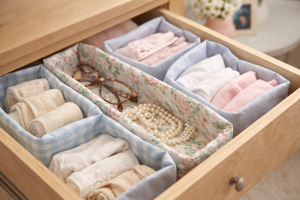
Once placed, the pillowcase can be adjusted and folded to fit the dimensions of the drawer. Excess fabric is tucked neatly along the edges, creating a smooth and fitted lining that not only looks organized but also feels intentional. From there, the pillowcase becomes more than just a liner—it transforms into a flexible structure that can be shaped into sections or compartments depending on storage needs. Socks can be grouped in one fold, undergarments in another, and accessories such as scarves or handkerchiefs can be separated without the need for plastic dividers or store-bought organizers.
In more creative variations of the method, older or mismatched pillowcases are cut and repurposed further. Some are sewn at the ends to form fabric sleeves or pouch-like compartments that can be placed directly inside drawers. These homemade organizers can be adapted for nearly any purpose. Jewelry can be stored safely in soft fabric pockets to prevent scratching. Office supplies such as pens, paper clips, and sticky notes can be sorted into sections. Even kitchen drawers can benefit, with utensils, napkins, or small tools separated in a way that keeps everything visible and accessible.
What makes this approach particularly appealing is its accessibility. Unlike modern storage systems that often require measurement, assembly, and financial investment, the pillowcase method requires nothing more than what most households already have on hand. There are no instructions to follow beyond basic folding, no specialized tools, and no additional cost. It is a solution born entirely from practicality, making it especially valuable in households where budgeting and resourcefulness are essential parts of daily life.
Another important advantage lies in how it affects daily routines. Organized spaces are not just visually pleasing; they also reduce mental friction. When items have clearly defined places, the act of getting dressed, preparing for work, or tidying up becomes faster and less stressful. Instead of rummaging through cluttered drawers, individuals can immediately see and access what they need. Over time, this small reduction in daily frustration contributes to a calmer and more efficient home environment.
There is also a subtle psychological benefit to using soft fabric instead of rigid plastic or metal organizers. Pillowcases create a gentler, more forgiving interior space. The texture of cloth adds warmth to storage areas that might otherwise feel purely functional or sterile. For many people, especially those who value comfort and familiarity in their living spaces, this softness contributes to a sense of ease that harder materials often lack.
Beyond practicality and comfort, the pillowcase drawer trick carries a deeper cultural resonance. It reflects a time when household management was guided less by consumption and more by creativity. Before convenience products became widely available, families relied on ingenuity to solve everyday problems. Nothing was discarded without consideration of its potential second use. A worn pillowcase did not signal waste—it signaled opportunity.
For many people who grew up observing parents or grandparents practice this kind of resourcefulness, the method evokes a sense of nostalgia. It recalls kitchens where jars were reused, containers were repurposed, and clothing was repaired rather than replaced. In that context, using a pillowcase as a drawer organizer was not unusual—it was simply normal. It represented a mindset where care and attention were applied not only to possessions but also to how those possessions were maintained.
In today’s world of fast consumption and constant upgrading, this simple trick offers something quietly refreshing. It challenges the assumption that better organization must come from buying new products. Instead, it suggests that order can be created through awareness, creativity, and the thoughtful reuse of what already exists. In doing so, it reconnects modern living with older values of sustainability and practicality.
It is also worth noting that this method is highly adaptable. It does not require uniformity or perfection. A slightly worn pillowcase works just as well as a new one. Different fabrics can be mixed depending on the drawer’s purpose. Even children can participate in organizing their own spaces using this technique, making it a useful teaching tool for responsibility and tidiness without turning it into a chore.
Ultimately, the pillowcase drawer trick is less about fabric and folding and more about mindset. It represents an approach to home management that values simplicity over complexity, usefulness over appearance, and resourcefulness over excess. While it may appear modest on the surface, its effects—reduced clutter, improved organization, saved money, and a calmer living environment—can be surprisingly meaningful when applied consistently.
In a world filled with increasingly complicated solutions to everyday problems, sometimes the most effective answer is the one that has been quietly waiting in a linen closet all along.