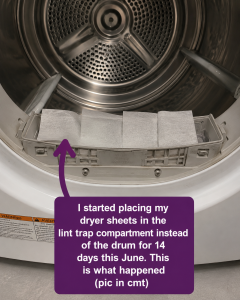
Experimenting with dryer sheets by placing them in the lint trap instead of directly tossing them into the dryer drum produced surprisingly mixed results over a 14-day period. What began as a simple curiosity-driven laundry experiment quickly turned into something more nuanced, revealing both subtle advantages and practical limitations. Rather than being a clear upgrade or downgrade from the traditional method, it became evident that this approach functions more as a situational technique than a universal improvement.
At the outset, the idea behind the experiment was straightforward: dryer sheets release softening agents and fragrance as they heat up and circulate during the drying cycle. By placing them in the lint trap compartment instead of the drum, the expectation was that airflow might carry those effects differently through the machine, potentially creating a more even distribution or even reducing residue on clothing. While not a widely recommended practice, it seemed harmless enough to test on everyday laundry.
One of the first noticeable outcomes during the experiment was a reduction in static cling. Synthetic fabrics, particularly athletic wear and polyester blends, typically emerge from the dryer clinging tightly together or to the sides of the drum. During the 14-day trial, those same items consistently came out with noticeably less static buildup. Clothes separated more easily, required less manual shaking during folding, and felt more manageable straight out of the dryer. For anyone who regularly deals with loads of mixed synthetic fabrics, this improvement alone stood out as a meaningful benefit.
Another positive change involved how fragrance was delivered to the laundry. Normally, when dryer sheets are placed in the drum, they tumble among the clothes and release a stronger, more immediate scent burst at the end of the cycle. In contrast, placing the sheet in the lint trap resulted in a lighter, more evenly distributed fragrance. Clothes still smelled fresh, but the scent was less concentrated and more subtle overall. For individuals sensitive to strong artificial fragrances, this gentler effect may actually be preferable, as it avoids overwhelming the senses while still maintaining a sense of cleanliness.
There was also a slight improvement in convenience during unloading. Because there were no dryer sheets physically mixed in with the clothes, there was no need to fish them out from inside sleeves, pillowcases, or tangled bedding. This small difference made the post-drying process feel marginally smoother and faster, especially when dealing with larger loads like towels or bed linens.
However, the experiment also revealed several drawbacks that balanced out these benefits. The most immediate downside was a noticeable reduction in fabric softness. While static control improved, towels, cotton shirts, and heavier fabrics did not feel as plush or conditioned as they typically do when a dryer sheet tumbles freely inside the drum. The mechanical contact between fabric and sheet appears to play a significant role in softness distribution, and removing that interaction seems to limit the full effectiveness of the product.
This trade-off became especially apparent with household linens. Bath towels, in particular, felt slightly rougher than usual after repeated use of the lint-trap method. Sheets and pillowcases also lacked the same level of smoothness that traditional drying methods typically provide. While the difference was not extreme, it was consistent enough to be noticeable over multiple loads.
Another unexpected observation involved the dryer sheets themselves. After each cycle, they appeared relatively unchanged compared to their usual state when used in the drum. This raised questions about efficiency.
It seemed likely that less direct tumbling contact reduced the rate at which the sheet’s softening agents were transferred to clothing. In other words, while the air circulation may have distributed fragrance more evenly, it may also have reduced the intensity of fabric conditioning. This created a sense that the product was not being fully utilized in the way it was designed.
There were also considerations regarding airflow and dryer performance. The lint trap is a critical component of dryer safety and efficiency, designed specifically to capture fibers and maintain proper air circulation.
Introducing foreign objects into or near this compartment, even something as thin as a dryer sheet, raises valid concerns. Although no immediate issues were observed during the 14-day experiment, experts generally caution that anything obstructing airflow paths in a dryer can potentially reduce efficiency over time or contribute to overheating risks if lint buildup is also present.
This aspect of the experiment highlighted an important point: even small modifications to appliance use can have unintended consequences if maintained long-term. While short-term testing showed no obvious problems, it would be irresponsible to assume that such a method is universally safe or recommended without manufacturer approval.
Energy efficiency was another subtle factor worth noting. Although not scientifically measured in this informal experiment, there was a slight impression that some loads took marginally longer to feel fully dry. This could be coincidental or related to airflow changes, but it suggested that even minimal interference with the dryer’s designed circulation system might influence performance.
Despite these drawbacks, the method was not without merit. It demonstrated that laundry outcomes can vary significantly based on how simple products like dryer sheets are used. The differences in static reduction versus softness, fragrance intensity versus subtlety, and convenience versus efficiency all pointed toward a central conclusion: there is no single “best” way to use dryer sheets, only different methods with different priorities.
For example, households that prioritize reducing static cling in synthetic clothing may find the lint-trap approach surprisingly effective. Gym wear, uniforms, and mixed fabric loads seemed to benefit most from this method. On the other hand, those who value softness above all else—particularly for towels, bedding, or cotton clothing—would likely prefer the traditional drum method where direct contact and tumbling action maximize conditioning effects.
Fragrance preference also plays a role. People who enjoy a strong, lingering scent after laundry cycles may find the lint-trap method too mild, while those who prefer a more natural or understated freshness may find it ideal.
Ultimately, the experiment suggested that the most practical approach is not to replace one method with another entirely, but to adapt based on laundry type and desired outcome. Using the lint-trap placement selectively—for example, on synthetic-heavy loads where static control matters most—while returning to traditional use for softening-focused loads offers a balanced compromise.
In conclusion, the 14-day trial revealed that this unconventional dryer sheet method is neither a breakthrough nor a failure. Instead, it is a situational technique with specific strengths and limitations. It improves static reduction and offers a gentler fragrance experience, but sacrifices some softness and raises questions about efficiency and long-term appliance safety.
The final takeaway is simple: small changes in everyday routines can produce noticeable differences, but those differences are rarely one-dimensional. In laundry, as in many household tasks, the best results often come not from rigid methods, but from understanding trade-offs and choosing the right approach for the right situation.