Laura San Giacomo didn’t vanish from Hollywood—she rewrote the terms of her success.
At a time when her career seemed poised to accelerate endlessly—fresh off the cultural impact of Pretty Woman and the sharp, comedic acclaim of Just Shoot Me!—she made a decision that, to outsiders, looked like a step back. Fewer red carpets. More selective roles. Less visibility in an industry that thrives on constant presence.
But what looked like absence was, in reality, intention.
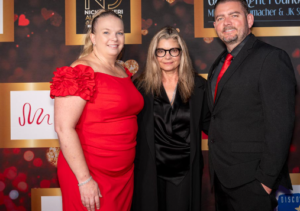
To understand that shift, it helps to go back to where her momentum truly began. Before she became a household name, San Giacomo had already proven her depth as a performer in Sex, Lies, and Videotape, a role that earned her critical acclaim and established her as more than just another rising actress. She had a distinct voice, a presence that blended sharp intelligence with emotional honesty. That early success positioned her for a long, high-profile career—and for a time, that’s exactly what she had.
Hollywood, especially in the early 1990s, rewarded visibility. The more present you were—on screen, on magazine covers, at premieres—the more you stayed in the public conversation. Careers were often built not just on talent, but on momentum. And San Giacomo had that momentum in abundance.
Then her priorities shifted.
Motherhood changed everything.
When her son Mason was born with Cerebral palsy, the trajectory of her life didn’t just adjust—it recalibrated completely. This wasn’t a moment of hesitation or uncertainty. By her own accounts over the years, it was a moment of clarity.
The fast pace of Hollywood, with its long shoots, distant filming locations, and unpredictable schedules, no longer aligned with what mattered most. Acting had always been her craft, her passion—but it was no longer the center of her life.
Instead of chasing momentum, she chose stability.
Instead of maximizing exposure, she prioritized presence.
And that distinction shaped everything that followed.
Television became her anchor—not by accident, but by design. Shows like Just Shoot Me! offered something film often couldn’t: consistency. A predictable schedule. A familiar set. The ability to return home at the end of the day rather than travel across countries for months at a time.
For many actors, television was once considered a step down from film. But for San Giacomo, it became a lifeline. It allowed her to remain creatively engaged while also being physically and emotionally present for her son.
That balance wasn’t just practical—it was essential.
Raising a child with cerebral palsy comes with challenges that extend far beyond what most people see. There are therapies to attend, medical appointments to manage, developmental milestones that may come differently or more slowly, and emotional landscapes that require patience, resilience, and constant attention.
Those aren’t responsibilities that can be put on pause.
And San Giacomo understood that deeply.
So she structured her life around them.
That meant making choices that didn’t always align with traditional Hollywood expectations. Turning down roles that required extended travel. Passing on opportunities that might have increased her visibility but reduced her availability at home. Choosing projects not just based on artistic merit, but on how they fit into the life she was building.
From the outside, those decisions could be misinterpreted.
In an industry that equates constant activity with success, stepping back—even intentionally—can look like fading away. But that interpretation misses the nuance of what was actually happening.
Because she didn’t stop working.
She simply became selective.
Throughout the years, she continued to appear in television series and film projects, including roles in shows like Saving Grace and guest appearances on long-running series such as NCIS. These roles may not have carried the same level of mainstream attention as her earlier work, but they allowed her to stay connected to her craft on her own terms.
And that distinction—on her own terms—is key.
Because while her on-screen presence became more measured, her off-screen voice grew stronger.
Over time, San Giacomo became deeply involved in advocacy work, particularly around disability awareness and inclusive education. This wasn’t a casual or occasional involvement. It was sustained, committed, and personal.
She worked with organizations like CHIME Institute, supporting programs that promote inclusive classrooms where children with and without disabilities learn side by side. She spoke publicly about the importance of access, understanding, and representation—not just in media, but in everyday life.
Her advocacy wasn’t abstract.
It was rooted in lived experience.
She wasn’t speaking about issues from a distance—she was navigating them daily. That gave her perspective a depth and authenticity that resonated with educators, parents, and communities alike.
In many ways, she was building a second legacy.
One that didn’t depend on ratings, box office numbers, or industry recognition, but on impact. Quiet, consistent, and deeply human.
It’s easy to overlook that kind of legacy because it doesn’t always make headlines. It doesn’t trend. It doesn’t dominate conversations in the same way blockbuster films or award-winning performances do.
But it matters.
And for many people, it matters more.
Meanwhile, her connection to acting never disappeared. It simply evolved.
She continued to take on roles that resonated with her—projects that aligned not just with her artistic interests, but with the life she had consciously designed. She wasn’t chasing relevance; she was choosing meaning.
That’s a subtle but powerful shift.
Living in the San Fernando Valley with her husband, Matt Adler, she created a life that balanced creativity with stability. It wasn’t about stepping away from Hollywood entirely—it was about redefining her relationship with it.
There’s a tendency, especially in celebrity narratives, to frame stories like hers in terms of sacrifice.
What was given up.
What could have been.
The roles she didn’t take. The projects she walked away from. The visibility she chose not to pursue.
But that framing misses the point.
Because it assumes that success has only one definition—and that it’s measured by visibility, fame, and career acceleration.
San Giacomo’s story challenges that assumption.
This wasn’t a retreat from success.
It was a redefinition of it.
She chose a version of success that prioritized presence over publicity, purpose over momentum, and impact over attention. She didn’t disappear—she redirected.
And in doing so, she created a life that many people, inside and outside the industry, quietly admire.
Because not all success is loud.
Not all impact is visible.
And not every meaningful story unfolds under bright lights.
In fact, some of the most enduring stories are the ones that happen away from the spotlight—built through daily choices, sustained commitment, and values that don’t shift with public opinion.
Laura San Giacomo’s journey is one of those stories.
It’s not defined by a single role, a single moment, or a single achievement. It’s defined by a series of decisions—each one intentional, each one aligned with what mattered most to her.
She didn’t follow the expected path.
She created her own.
And in doing so, she offers a different kind of narrative—one that expands how we think about success, fulfillment, and legacy.
Because in the end, her story isn’t about stepping away.
It’s about stepping toward something more meaningful.
She didn’t fade from Hollywood.
She simply chose a life where the most important role she would ever play wasn’t written in a script—and that choice, far from diminishing her story, is exactly what makes it lasting.