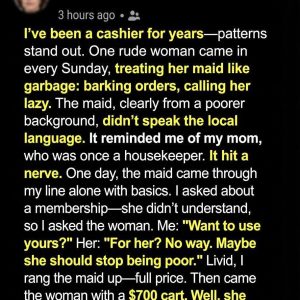
At first glance, the famous “cash register riddle” looks almost laughably simple. Most people read it once and immediately feel certain they know the answer. But within seconds, confusion starts to creep in. Suddenly, the math doesn’t feel so obvious anymore. People begin arguing in comment sections, debating with friends, and confidently throwing out wildly different answers.
Some insist the store lost $200. Others say the correct answer is $170. A few claim it must be $130. Meanwhile, another group argues passionately that the loss was only $100.
So why does such a basic scenario create so much chaos online?
The answer lies in the way the human brain processes movement, ownership, and value. The riddle is not difficult because of arithmetic. In fact, the math itself is extremely simple. What makes the puzzle so effective is the wording. It tricks people into counting the same $100 bill multiple times without realizing it.
Over the years, this riddle has spread across social media platforms, forums, classrooms, and even workplace discussions. It repeatedly goes viral because it exposes something fascinating about human thinking: our brains often overcomplicate problems that require simple logic.
The scenario itself reads like this:
A man sneaks into a store and steals a $100 bill directly from the cash register. Later, he returns to the same store pretending to be a customer. He buys $70 worth of merchandise using the exact same $100 bill he stole. The cashier accepts the money, places it back in the register, and gives the man $30 in change.
The question is simple:
How much money did the store lose?
At first, many people begin mentally tracking every movement of the bill. That is exactly where the confusion begins. The moment people start following the $100 separately from the merchandise and separately from the change, the calculations become messy.
Some immediately say:
“The store lost the original $100, plus $70 in goods, plus $30 in cash. That equals $200.”
It sounds convincing at first. After all, the thief did steal $100 initially. Then he walked away with merchandise and change. But this logic contains a hidden mistake: it counts the same $100 twice.
That stolen bill eventually came back into the register when the thief used it to pay for the merchandise. Once the bill was returned, it was no longer part of the store’s losses.
This is the key detail that makes the riddle so deceptive.
To fully understand the answer, it helps to slow everything down and examine the situation step by step.
Step One: The Initial Theft
The thief steals a $100 bill directly from the register.
At this exact moment, the store is missing $100 in cash.
Current loss:
$100
Simple enough so far.
Step Two: The Thief Returns
Later, the thief comes back pretending to be a normal customer. He selects $70 worth of goods and pays with the same stolen $100 bill.
This is the moment where most people’s brains get tangled.
The cashier receives the $100 and places it back into the register. That means the store’s missing cash has now been restored. The original stolen money is no longer missing.
The register is back to normal.
However, the store now hands over two things to the thief:
$70 worth of merchandise
$30 in change
These are the only things permanently leaving the store.
Step Three: The Final Outcome
At the end of the transaction, the thief walks away with:
$70 in goods
$30 in cash
Total:
$100
That is the store’s actual loss.
Nothing more.
Nothing less.
The confusion exists because people mentally separate the theft and the purchase into unrelated events, even though the same bill connects them.
Another way to understand the riddle is to ignore the movement of the stolen bill entirely.
Imagine this simplified version:
A thief walks into a store and somehow leaves with $70 worth of merchandise and $30 cash without giving the store any legitimate money.
How much did the store lose?
Obviously, the answer is $100.
That is exactly what happened in the original riddle. The extra details about stealing the bill first simply distract the brain and create the illusion of additional losses.
Psychologists often point to riddles like this as examples of “cognitive overload.” When too many moving parts are introduced, the brain tends to lose track of what actually matters. Instead of focusing on the final outcome, people become trapped following every transaction individually.
This is why arguments about the answer can become surprisingly intense online.
People become emotionally attached to their calculations because the incorrect answers often feel logical. Someone arguing for $200 genuinely believes they are accounting for every missing item. In reality, they are accidentally charging the store twice for the same $100 bill.
The most common incorrect answers usually come from these misunderstandings:
The $200 Mistake
People who answer $200 typically calculate:
$100 stolen initially
$70 merchandise
$30 change
But the flaw is obvious once pointed out: the original $100 returned to the register. It was not permanently lost.
The $170 Mistake
Some argue the store lost $170 because they think the merchandise should be added on top of the original stolen bill while partially accounting for the returned cash.
Again, this double-counts value already restored.
The $130 Mistake
Others subtract incorrectly or confuse profit versus inventory value, arriving at numbers like $130.
These answers usually come from overcomplicated mental accounting.
The beauty of the riddle is that it forces people to confront how easily the mind can become distracted by unnecessary details.
In reality, the store owner would close the register at the end of the day and notice only two missing things:
$70 worth of inventory
$30 cash
That’s it.
Total missing value:
$100
Interestingly, riddles like this often spread rapidly online because they encourage participation. Everyone wants to prove they are right. Even people who normally avoid puzzles feel compelled to solve it because the setup sounds so easy.
That’s part of the psychological trap.
The simpler a riddle appears, the more confident people become. When conflicting answers suddenly appear in comment sections, people begin doubting themselves and re-reading the scenario repeatedly. The debate becomes addictive.
Social media has amplified the popularity of these logic puzzles enormously. Posts featuring this exact riddle regularly generate thousands of comments, with users passionately defending their calculations. Entire threads emerge where people write long explanations attempting to prove why their answer is correct.
Ironically, the answer remains extremely straightforward once emotion and overthinking are removed from the equation.
Teachers and puzzle enthusiasts often use this riddle to demonstrate the importance of focusing on net loss rather than tracking every temporary movement individually. Accountants and business professionals especially enjoy the puzzle because it mirrors real-world mistakes people sometimes make when handling transactions mentally instead of systematically.
The lesson extends beyond mathematics.
The riddle also highlights how easily humans complicate situations by focusing on the wrong details. In everyday life, people often become overwhelmed because they mentally track every small movement instead of examining the final outcome.
That’s why the puzzle feels satisfying once the solution clicks.
There is a brief moment where everything suddenly becomes obvious, and the confusion disappears instantly.
You realize the problem was never about advanced math at all.
It was about perspective.
If you focus on what permanently left the store, the answer becomes crystal clear.
The store temporarily lost a $100 bill.
The same $100 bill returned to the register.
The thief permanently left with $70 worth of goods and $30 cash.
Final loss:
$100
That is the only value the store no longer possesses after the transaction ends.
Despite the endless debates online, no complicated formulas are needed. No algebra is required. No hidden trick changes the math.
The riddle succeeds because it manipulates attention, not because it contains difficult calculations.
And perhaps that is why it continues to fascinate people year after year. It reminds us that the brain can sometimes create confusion where none actually exists.
By slowing down, ignoring distractions, and focusing only on the final result, the answer becomes impossible to miss.
The store lost exactly:
$100.