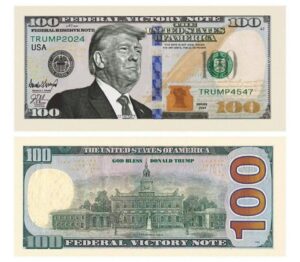
The idea of a redesigned U.S. dollar bearing the signature of a sitting president—especially one as prominent and polarizing as Donald Trump—represents a striking departure from longstanding American tradition. The concept, often framed around the upcoming 250th anniversary of the United States, has sparked curiosity, excitement, skepticism, and debate in equal measure. If such a change were to occur, it would not only alter the physical appearance of American currency but also reshape the symbolic meaning attached to it.
For over two centuries, the U.S. Dollar has followed a relatively consistent philosophy: it honors historical figures, not active political leaders. Presidents like George Washington, Abraham Lincoln, and Andrew Jackson appear on bills not because of their contemporary influence, but because of their lasting legacy after leaving office. This separation between current political power and national symbols has been a cornerstone of American democratic identity. It reinforces the idea that institutions, not individuals, define the nation.
The notion that Donald Trump could become the first sitting president in history to have his name—or even his signature—appear on U.S. currency challenges that precedent in a profound way. Supporters of the idea argue that it would mark a historic milestone, especially if tied to the celebration of America’s 250th anniversary, often referred to as the Semiquincentennial. In their view, such a gesture could symbolize a bold, modern chapter in American history, reflecting a break from tradition that mirrors the unconventional nature of Trump’s political career.
The argument often begins with symbolism. Currency is more than just a medium of exchange—it is a storytelling device. Every bill carries images, mottos, and signatures that reflect the nation’s identity, values, and priorities. The addition of a sitting president’s signature could be interpreted as a way to directly connect leadership with the economic life of the country. In this sense, proponents see it as a powerful visual statement: a leader actively shaping the nation during a landmark anniversary.
There is also a historical argument that comes into play. While no sitting president has had their name on circulating currency in this manner, signatures do already exist on U.S. bills—typically those of the Treasury Secretary and the Treasurer of the United States. Expanding that to include a presidential signature would not be entirely unprecedented in format, but it would be unprecedented in meaning. It would elevate the role of the president within the symbolism of the currency itself.
However, critics are quick to point out that such a move would blur the line between governance and personal legacy. One of the fundamental principles of American democracy is the peaceful transfer of power and the avoidance of personality-driven rule. Placing a sitting president’s name on money could be seen as elevating an individual above the office, potentially setting a precedent that future leaders might follow or exploit. This concern is especially relevant in a political climate where public trust and institutional integrity are constantly under scrutiny.
Another important factor to consider is the legal and procedural framework behind U.S. currency design. Changes to the appearance of money are not made lightly. They involve multiple government agencies, including the Bureau of Engraving and Printing and the U.S. Department of the Treasury. Any significant redesign typically undergoes years of planning, testing, and approval. Security features, anti-counterfeiting measures, and accessibility considerations all play a role in shaping the final product. Introducing a presidential signature would require not just political will, but also legislative or administrative changes to existing policies.
From a design perspective, the addition of Donald Trump’s signature could open the door to a broader reimagining of the dollar. The 250th anniversary of the United States presents an opportunity to update currency in ways that reflect both tradition and innovation. Designers might incorporate new imagery, modern typography, and enhanced security features while maintaining the recognizable elements that give the dollar its identity. In this context, the signature could serve as one piece of a larger commemorative redesign.
Public reaction to such a change would likely be deeply divided. For some, it would be a source of pride—a tangible representation of a leader they admire and a moment in history they wish to celebrate. For others, it could feel like an inappropriate politicization of a shared national symbol. Currency is one of the few objects that all citizens interact with regularly, regardless of political affiliation. Altering it in a way that highlights a current political figure risks turning a unifying symbol into a point of contention.
Internationally, the impact would also be significant. The U.S. dollar is not just a national currency; it is a global reserve currency used in trade, finance, and investment around the world. Any major change to its design attracts attention from governments, financial institutions, and markets worldwide. A redesign tied to a specific political figure could influence how the currency is perceived abroad, potentially affecting its image as a stable and neutral standard.
There is also the question of precedent. If Donald Trump were to become the first sitting president to have his name on U.S. currency, what would that mean for future administrations? Would subsequent presidents seek the same recognition? Would it become a tradition tied to major anniversaries, or remain a one-time exception? These questions highlight the broader implications of what might initially seem like a symbolic gesture.
Supporters often frame the idea within the narrative of disruption. Trump’s presidency has been characterized by a willingness to challenge norms and redefine expectations. In that sense, a currency redesign featuring his signature would be consistent with that approach. It would signal a break from the past and an embrace of a more personalized form of leadership symbolism. For those who value this style of governance, the idea holds strong appeal.
On the other hand, opponents argue that some traditions exist for a reason. The absence of living figures on U.S. currency is not just a coincidence; it reflects a deliberate effort to avoid the appearance of monarchy or authoritarianism. The founders of the United States were deeply wary of concentrated power and the cult of personality. Maintaining a clear distinction between current leaders and national symbols has been one way to uphold that principle.
The timing of the proposed change adds another layer of complexity. The 250th anniversary of the United States is a moment of reflection as much as celebration. It invites Americans to look back on their history, assess their present, and consider their future. Decisions made in this context carry added weight, as they contribute to the narrative that will define the nation’s identity for years to come.
If a redesigned dollar featuring Donald Trump’s signature were to be introduced, it would likely be part of a broader commemorative effort. Special editions of currency, coins, and other memorabilia are common during major anniversaries. These items often become collectibles, valued not just for their monetary worth but for their historical significance. In this scenario, the signature could be positioned as a limited or symbolic addition rather than a permanent change to all circulating currency.
Ultimately, the debate over this idea reflects deeper questions about identity, leadership, and tradition in the United States. It is not just about the appearance of money, but about what that appearance represents. Should national symbols remain rooted in the past, honoring figures whose legacies have stood the test of time? Or should they evolve to reflect the present, even if that means embracing controversial or unconventional choices?
There is no simple answer. The strength of a democratic society lies in its ability to have these conversations openly and thoughtfully. Whether or not the U.S. dollar ever features the name or signature of a sitting president, the discussion itself highlights the dynamic nature of American identity. It shows that even the most familiar objects—like the bills in our wallets—can become catalysts for reflection and debate.
In the end, the idea of Donald Trump becoming the first sitting president to have his name on U.S. currency in honor of America’s 250th anniversary is as much about symbolism as it is about policy. It challenges long-held norms, invites passionate responses, and underscores the evolving relationship between leadership and national identity. Whether viewed as a bold innovation or a controversial departure from tradition, it is a concept that captures attention and sparks conversation—exactly the kind of discourse that defines a vibrant democracy.