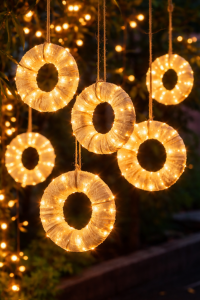
There is something quietly satisfying about taking objects that were never meant to be “design materials” and turning them into something that changes the feeling of a space entirely. A simple pool noodle paired with LED lighting is a perfect example of that transformation.
What begins as a lightweight foam cylinder designed for floating in a swimming pool suddenly becomes something else entirely once light is introduced. On its own, a pool noodle is unremarkable—bright, playful, and disposable in function. But when a strip of LEDs is carefully inserted or wrapped along its length, the material stops being a toy and starts acting like a diffuser. The foam softens the intensity of the light, spreading it outward in a way that removes harsh edges and replaces them with a smooth, ambient glow.
The result is surprisingly atmospheric.
Instead of seeing individual bulbs or sharp beams, you get a continuous band of color that feels almost organic, as if the light itself is gently radiating from within the structure rather than being projected onto it. This subtle diffusion is what makes the effect so compelling. It doesn’t overwhelm the space—it reshapes it quietly.
In a backyard setting, especially after sunset, this kind of lighting changes everything about how the environment is perceived. Familiar objects—chairs, fences, plants, even the texture of the ground—take on a softened visual identity. Shadows become less harsh. Corners lose their rigidity. The entire space begins to feel more cohesive, as though the boundaries between functional areas have blurred into something more fluid and intentional.
What is particularly interesting about this approach is how it contrasts with traditional outdoor lighting design. Conventional landscape lighting often relies on fixed fixtures, electrical installation, and carefully directed beams meant to highlight specific features. It is structured, deliberate, and often expensive. By comparison, pool noodle lighting is informal and adaptable. It doesn’t require permanent installation or technical expertise. It invites experimentation rather than precision.
A strip of LED lights can be cut, extended, repositioned, or recolored depending on mood or occasion. The pool noodle itself can be bent into arcs, arranged in straight lines, or shaped into soft curves that guide the eye through a space. Two or three pieces can define a pathway. A cluster can frame a seating area. Hanging versions can create suspended glowing forms that resemble floating light sculptures when viewed from a distance.
This flexibility is part of what makes the concept so appealing. It lowers the barrier between idea and execution. There is no need for a landscape architect or a detailed plan. Instead, there is room for improvisation—an ongoing process where the space evolves over time rather than being finalized in a single design phase.
Beyond aesthetics, there is also a psychological shift that comes with this kind of lighting. Human behavior is deeply influenced by light levels and color temperature, often in ways that go unnoticed. Harsh lighting tends to signal alertness, productivity, or urgency. Softer, diffused lighting signals rest, openness, and social comfort.
When a backyard is illuminated with this kind of gentle glow, people tend to linger longer. Conversations stretch out naturally. Movement slows. The environment feels less like an outdoor extension of utility and more like an intentional place of gathering. Even simple activities—sitting, talking, sharing food or drinks—feel more meaningful when the surrounding light encourages stillness rather than stimulation.
There is also something inherently communal about DIY lighting projects like this. Because the materials are inexpensive and widely available, they invite participation rather than observation. A family doesn’t need specialized tools or technical knowledge to take part. Children can help arrange shapes. Adults can manage placement and power sources. Everyone contributes to the outcome, even in small ways.
This shared involvement becomes part of the final atmosphere. The finished space is not just decorated—it is collectively built. And that shared effort subtly embeds itself into the experience of the environment. The glow of the lights becomes associated not only with visual comfort, but with the memory of creating it together.
Seasonal adaptability adds another layer to its appeal. The same setup can be reimagined for different occasions with minimal effort. Warm white tones might create a calm, everyday ambiance for quiet evenings. Vibrant colors can shift the mood entirely for celebrations or holidays. Arrangements can be expanded for gatherings or scaled down for solitude. The system remains fluid, always ready to adapt to the intention behind it.
Even the imperfections contribute to its charm. Unlike professionally installed lighting systems that aim for uniformity, handmade configurations often carry slight irregularities—gentle bends, uneven spacing, subtle variations in brightness. Instead of diminishing the effect, these imperfections often make it feel more human. Less manufactured. More lived-in.
Over time, the space begins to develop a kind of identity shaped by these choices. What was once a standard backyard becomes something recognizable and personal. Not because it is expensive or elaborate, but because it reflects the people who shaped it. Their preferences, their creativity, their willingness to experiment with simple materials.
In that sense, the glow produced by pool noodle lighting is not just illumination in the physical sense. It becomes atmosphere in a broader sense—an emotional quality that defines how the space feels rather than how it looks. It carries traces of intention and presence, transforming ordinary evenings into experiences that feel slightly more memorable than they would otherwise be.
And perhaps that is the most compelling part of all. It demonstrates that transformation does not always require complexity or cost. Sometimes it only requires attention—seeing potential in something overlooked, and being willing to reimagine what it can become when placed in a different context.
A pool noodle and a strip of LEDs are, on their own, simple objects with clear and limited purposes. But together, they become something else entirely: a reminder that atmosphere is often built not from what we buy, but from how we choose to see what is already in front of us.